

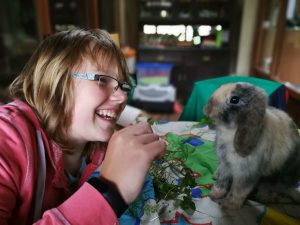
 For about 8 years I have been involved with the relationships between humans and animals at the farmyard “Seminarhaus Idensen”. In the beginning we offered horse drawn carriage rides for school classes of physically and mentally challenged children. During this time the variety of animals has grown and we now have sheep, geese, chickens, rabbits, cats and a dog. It is very important to us that these animals are socialized and seek out contact with people. Because the animals are raised this way the children (and sometimes the guests from the “Seminarhaus”) can easily associate with the animals and both the animals and the humans enjoy this contact very much.
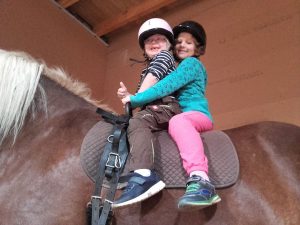 Typically a child will show a preference for one of the animals over all the others. Some especially enjoy riding one of the calm cold-blooded-horses and it makes them proud and happy. To be a partner of one of these heavy draught animals builds their self-confidence and has a long term positive effect.
On the other hand, the children learn to accept limits set by the animals.
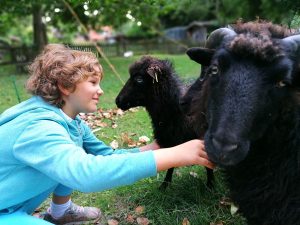
When working with the animals, the children are naturally confronted with limits which have to be accepted – experience has shown that the children happily accept these realities. For example: Sheep (especially Skudden) will immediately run off when they are surrounded by hectic, careless movements. If one wants to get near them, one has to be very gentle, be quiet and have patience.
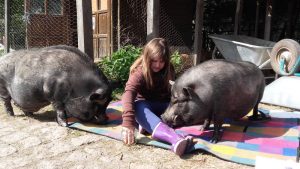 The animal-child-relationship cannot be compared with a relationship between other children or grownups. The child looks into the eyes of the dog, horse or cat and builds up a relationship which is not subject to normal rules. It is an understanding without words, without verbal interaction. You can’t fool an animal; it does not prejudge a relationship.
My dog always knows if something has gone wrong and I am really down. Instinctively he backs me up in a very special way. But he does not think I am a “loser”, he does not judge. (This also applies to horses.)
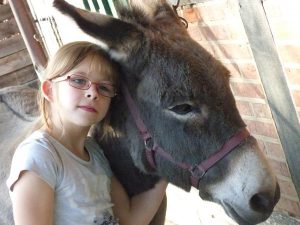 Experience shows that children and teenagers lose their fear of the animals sooner or later – even though they have had this anxiety or fear for a long time. Losing this fear is a pleasant and long lasting experience and generates a feeling of pride over the achievement. The children are mentally better balanced, relaxed and happy. The children and teenagers are willing to trust this new partner, become more self assured and “grow” with this new relationship.
They even feel, that they are superior to the animal – the animals rely on the humans to look after them – and that they will have to take care and be responsible.
Animals forgive misbehaviour relatively quickly and they are not resentful. Only repeated bad treatment of an animal will cause the animal to no longer trust the human.
The children don’t just play with the animals, they also are happy to help with the necessary chores: they clean the stables, they groom the horses, and they help shear the sheep. They enjoy the experience of being responsible, to be important and to accomplish something valuable.
I do not have the academic background to evaluate the psychological effects the children experience while in contact with the animals. But the teachers and volunteers all agree that the following effects are noticeable:
- the children lose their fear
- they are relaxed
- they are less hyperactive
- they are less likely to act aggressively including with each other
- they develop trust
- they enjoy nature; knowingly or unknowingly
- they develop self confidence
- they have more intense interpersonal relationships even with adults
This experience makes everybody involved happy.
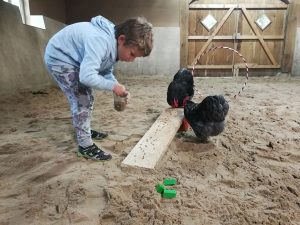 At the moment a teacher from the local Paul-Moor-School (for physically and mentally challenged children) takes part in an additional trainee program for animal science of education. This will be a great benefit for the work of the “Animal Helps Human” foundation in future activities. Another project is run by the “Wunstorfer Fröbelschule” for children who have difficulties with learning. They have practice orientated lessons in biology here at the farmyard: getting in contact with the animals and learning about their care and needs.
Ethical values and standards are easily communicated in this relaxed atmosphere; situations which have nothing to do with school can be practiced without stress. This environment is most helpful for pupils that have a background where education and behaviour does not seem very important to them. With this program we can give these pupils a way to participate in normal social life.
As Alexander Mitscherlich said: young people need one of its kind – animals, elements like water, dirt, fields, mental scope. You can raise a child without all this, with carpets, soft toys, on tarmac streets and backyards. It will survive but one should not be surprised if it will not learn some of the social achievements in later life.
Nowadays children grow up more and more in a virtual world of computer games and many other media. This environment leads to passive behaviour and the lack of concentration.
At the farmyard the children can actively experience and enjoy animals, water, dirt and nature and therefore get in closer contact with themselves. I could also imagine that the contact to animals will make children less aggressive.
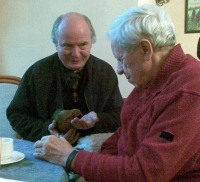 By the way, the animals also have a positive effect on the guests of the “Seminarhaus”. These are often groups of people who don’t know each other. My dog “Bodo” for instance is an ideal communicator and mediator; he manages to get rid of peoples reservations in no time at all. It is my experience that adults, especially elderly people become more relaxed when they have contact to animals. Spontaneous laughter or a remembering smile often proves this.
Summary
We experience the positive effects on humans caused by animal contact every day. With children – physically or mentally challenged – this effect is even larger. For the teachers, volunteers and me this project is a valuable, fulfilling experience. And I believe, it is also good for the animals. They are naturally curious and want to have a job. This applies especially to dogs, but also horses, sheep and geese who all want to be more than just a lawn mower.